

What do a mirage and a bubble have in common? Probably nothing, but there is a connection between them: when you live inside a bubble, you see everything through that glass, and because of the very nature of bubbles, the distortion you experience when looking through them is quite significant.
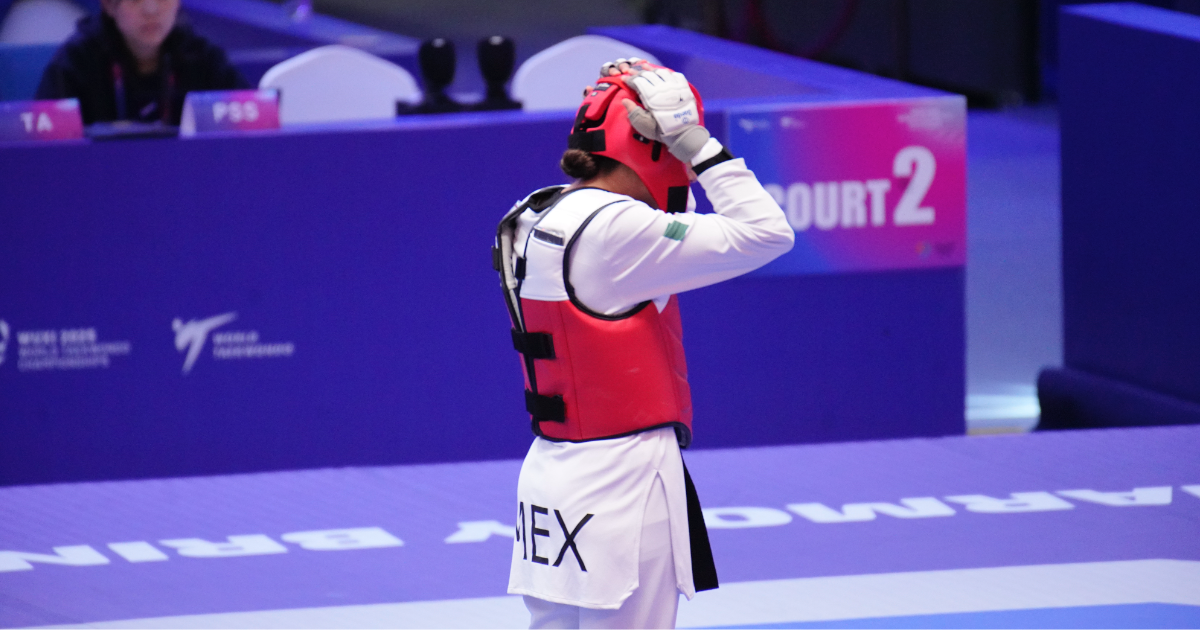
This is relevant because yesterday in Wuxi, the Mexican team suffered two more setbacks in the World Taekwondo Championships: Mariana Zambrano and David Valdés. Both were key contenders in the competition because they had demonstrated their skill in previous events they had participated in; however, as I said yesterday, we’re not in Kansas anymore…
Mariana's case is significant because she beat a world champion, Daniela Souza, in the trials for this event. This is nothing new; for years and years, world, Pan American, collegiate, and even Olympic champions and medalists have fallen to a fellow countryman in some internal qualifying event—even the greatest Mexican athlete of all time suffered that fate (I won’t even mention her name; you know who I’m talking about).
In addition to her performance, Mariana has been one of the most consistent athletes in her competitive career in recent years: she won the Central American Junior Games in Asunción and is one of the few athletes on the continent to have competed in virtually every Panama Series event held between last year and this year. Within the team, she is one of the very few natural replacements—a group that is practically nonexistent today—and that tells us that, at least for her, she is on the right track. However, despite all of the above, I believe the World Championships are proof that there is still a lot of work to be done and that the clash of American styles with those of other regions should, if not be constant, at least not be unusual or occur in the context of a world championship where it is already too late.
Mariana had a tough match yesterday, and I think there’s a valuable lesson to be learned from it: she won one fight by a narrow margin and lost the other due to a lack of experience. We have to keep working—there’s no other way—but we have to work smart, because once you get past the round you lose due to inexperience, the round begins where you start to see what you’re made of. Look at the medalists in that category: ALL of them are over 5’8” tall. I don’t know if Mariana has ever faced someone not only that tall but also at that same technical level, but if the goal is to become a real hope for Mexico, she has to learn to take down giants—and there aren’t any like that in the Pan American region.
Valdés’s case is also telling; there’s no doubt he’s a massive, natural talent, but natural talent alone isn’t enough at that weight class (or any other), and his immense talent is simply the result of the fact that we’ve only seen him in local and friendly competitions—that is, within the bubble. It might seem like things would be similar outside of it, but they’re not. Anyone who wants to peek outside the bubble should take a look at yesterday’s round of 32 and see that our young talent, at least as of today, is practically a rookie on that list of killers.
Don't get me wrong—I still believe that young Valdés has a bright future ahead of him and could become one of Mexico's legendary greats, but it won't happen soon, or quickly, or at the pace he's currently working. Right now, he's far from being the dark horse many of us were hoping for (and I count myself among them).
Mexico took to the mat in Wuxi yesterday to face a harsh reality check—not necessarily a bad thing, but certainly painful. The good thing about pain is that you can learn from it, and the good thing about taekwondo is that there’s always another chance, and I hope to be there to see it.

Great point, Chava.
I appreciate that Mexico has stopped focusing on international competitions. I remember a few years back their tours through Europe—on the strong circuit in Belgium, the Netherlands, and Spain—where they would bring two or even three athletes per category, and even some juniors. I believe—and correct me if I’m wrong—that they haven’t done this in years. If they rely entirely on domestic competition or the South American circuit for their preparation, they’re finished; talent is honed through these kinds of experiences.
From the outside, no one considers a Mexican athlete a favorite or someone to watch anymore; they’re completely out of the running for favorites in any category.
If they still think the goal is to win a medal, they’re completely wrong; the objective now is exactly what you pointed out—not to be too hard on the athletes, but to reflect on where Mexican taekwondo stands right now and start implementing solutions or tools to climb back up the ranks and regain the status Mexican taekwondo once had.